Nevada CME Requirements and CME Courses
1 - 4 of 4 results
-
BoardVitals Addiction Medicine CME Board Review
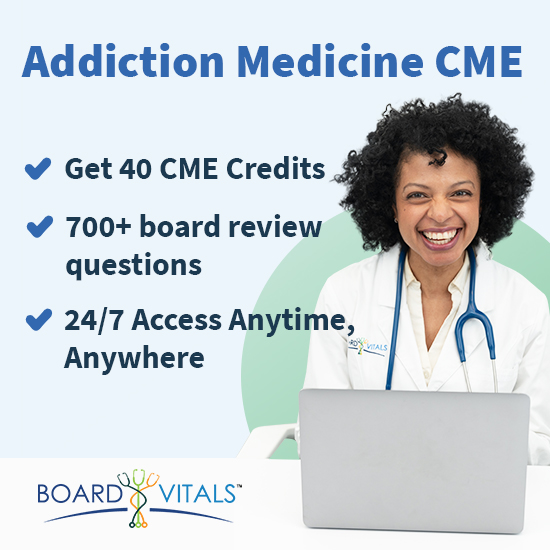
The BoardVitals Addiction Medicine CME Review offers clinicians 40 AMA PRA Category 1 CreditsTM and over 700 Addiction Medicine board review questions. The questions cover key topics including recognition, intervention, and treatment of addiction. This question bank will assist clinicians with Addiction Medicine certification and recertification.
The BoardVitals Addiction Medicine CME Review also features:
- Quick and Convenient CME
- Computer, phone, and tablet access
- Constantly updated up-to-date questions
- Questions that are targeted specifically to the exam
- Online CME tracker
- 100% Pass Guarantee
- Statistical comparison to other Addiction Medicine test-takers (Nationally)
After completing this activity, you should be able to:
- Identify the most commonly abused substances
- Recognize the most common indicators and symptoms of substance abuse and pain medicine dependency
- Describe the underlying pathophysiology of disease and basic science knowledge
- Formulate treatment for chronic pain management and substance abuse
Target Audience: Care providers concerned about issues of chronic pain and substance abuse.
See full details chevron_right- Cost: $619
- Credit hours: 40
- CME credits awarded by: BoardVitals
- Format: On-Demand Online
- Material last updated: Continuously Updated
-
PRESENT DEA Mate Training- Saturday, April 18
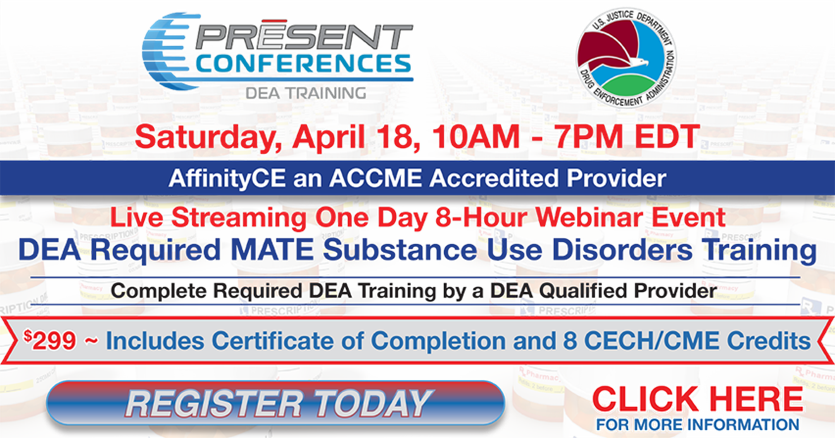
When you attend the DEA Required Substance Use Disorders Training, you will obtain 8 CECH/CME credit that you can apply toward your state requirement. This course is developed and accredited by AffinityCE, an ACCME accredited and DEA-qualified provider. PRESENT e-Learning Systems is approved by the Council on Podiatric Medical Education as a provider of continuing education in podiatric medicine, and has approved this activity for 8 continuing medical education contact hours.
See full details chevron_right- Cost: $299
- Credit hours: 8
-
BoardVitals Addiction Medicine Board Review Question Bank
The BoardVitals Addiction Medicine Board Review Question Bank offers over 800 Addiction Medicine Certification Review / Addiction Board Review questions. The exams cover recognition, intervention, and treatment of addiction. This question bank specifically covers the topics published by the ABAM and ABPN for Addiction Medicine Certification.
The BoardVitals Addiction Medicine Board Review Question Bank features:
• Timed Mode
• Statistical Comparison to Other Addiction Medicine Test Takers (Nationally)
• Questions That are Targeted Specifically to the Exam
• 100% Pass GuaranteeTarget Audience: Physicians focusing on Addiction Medicine
See full details chevron_right- Cost: $159
- Credit hours: 40
- CME credits awarded by: University of Nebraska Medical Center
- Format: On-Demand Online
- Material last updated: Continuously Updated
-
AchieveCE American Addiction
Every 7 minutes in our country, a person dies from a drug overdose, while a child is also born approximately every 30 minutes dependent on opioids. How do we as healthcare professionals offer non-stigmatic patient care and contribute to the progress of society in the right direction? Substance use disorder (addiction) is likened to an iceberg or a weed, in that the issues underneath the surface are typically even more complicated than what is viewed from the surface. Addiction spans hundreds of substances of abuse highlighted by stimulants (cocaine and methamphetamine), cannabis (plant, synthetics, and extracts), and opioids (heroin, fentanyl, and carfentanyl). As one can recall with the substance of ethyl alcohol (i.e. beer, wine, and hard liquor), a substance may never actually chemically change, yet can move across legal classifications of substances, leaving all healthcare professionals in need of knowledge on all substances of abuse. Opioid use disorder (opioid addiction) is combated with the medication-assisted treatments (MAT) of naltrexone, methadone, and buprenorphine, while opioid overdose respiratory depression is reversed with naloxone. Over the course of this activity, we will aim for “higher” education on all of these dynamic aspects. Unlike opioids, this activity is sure to open your eyes and possibly even elevate your blood pressure and/or heart rate!!!
See full details chevron_right- Cost: $20
- Credit hours: 1.5
- CME credits awarded by: 1 AMA PRA Category 1 Credit™ by Continuing Education Company, Inc. and AchieveCE, ACPE, AGD PACE, and ANCC.
- Format: Online Video
- Material last updated: 03/15/2025
- Expiration of CME credit: 03/15/2028