Urology CME
1 - 18 of 18 results
-
SAVE 20%. USE CODE CME20
Oakstone CME Comprehensive Review of Urology
Urology CME: Diagnostic Approaches, Therapeutic Advances
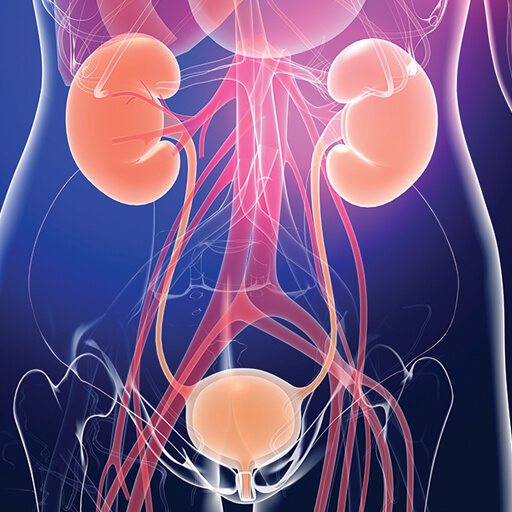
Comprehensive Review of Urology provides current, relevant information on adult and pediatric disorders of the male and female urinary tract, the male reproductive system, and the kidney. Led by renowned urologist Aria F. Olumi, MD, lecturers use guideline-driven information that will improve your approach to screening, staging, diagnosis, and treatment. You’ll get expert take-home points from each continuing medical education lecture, including:
- MRI of Prostate Cancer. MRI is effective in detecting focal areas of highgrade prostate cancer, providing accurate locoregional staging, and guiding targeted biopsies.
- Kidney Cancer – Laparoscopic Management. Laparoscopic and robotic nephrectomy is now the standard care for most renal cell carcinoma patients. It offers significant advantages in morbidity while maintaining oncologic outcomes of open surgery.
- The Etiology and Treatment of Pelvic Organ Prolapse. Vaginal wall descent is a normal part of aging; however, once the bulge protrudes past the hymen, most women are symptomatic.
- Advances in Systemic Therapy for Management of Muscle Invasive Bladder Cancer. Neoadjuvant chemotherapy remains the standard of care for muscle-invasive bladder cancer.
- And many more!
- Cost: $1195
- Credit hours: 62.75
- CME credits awarded by: Oakstone Publishing, LLC
- Format: On-Demand Online, Online Video, Online Audio, Audio CD
- Material last updated: October 31, 2024
- Expiration of CME credit: October 30, 2027
-
FEATURED
BoardVitals Urology CME Board Review
The BoardVitals Urology CME Review offers clinicians 40 AMA PRA Category 1 CreditsTM and over 700 Urology board review questions. The questions cover key topics including bladder cancer, bladder dysfunction, and infertility. This question bank will assist clinicians with Urology certification and recertification.
The BoardVitals Urology CME Review also features:
- Quick and Convenient CME
- Computer, phone, and tablet access
- Constantly updated up-to-date questions
- Questions that are targeted specifically to the exam
- Online CME tracker
- 100% Pass Guarantee
- Statistical comparison to other Urology test-takers (Nationally)
After completing this activity, you should be able to:
- Diagnose common and rare disorders which may be encountered in Urology.
- Order and interpret results of common laboratory tests in Urology.
- Describe the range of available treatments and essential concepts in the field of Urology
Target Audience: Urologists
See full details chevron_right- Cost: $639
- Credit hours: 40
- CME credits awarded by: BoardVitals
- Format: On-Demand Online
- Material last updated: Continuously Updated
-
FEATURED
Oakstone CME Practical Reviews
Practical Reviews offers journal summaries from leading medical journals. This activity makes earning CME credits quick and easy and helps physicians stay up to date on the latest advances and news in their specialty.
Practical Reviews is offered in over 20 specialties and can be accessed via online video, online audio, audio cd, or the convenient Practical Reviews mobile app.
See full details chevron_right- Cost: Varies depending on course
- Credit hours: 56-70
- CME credits awarded by: Oakstone Publishing
- Format: On-Demand Online, Online Video, Online Audio, Audio CD, Mobile App
- Material last updated: Continuously Updated
-
SAVE 20%. USE CODE CME20FEATURED
Oakstone CMEssentials+
Practical CME for Busy Clinicians
See full details chevron_right
CMEssentials+ is the next generation of practical CME — built for the way clinicians actually learn today. It focuses on essential clinical topics and delivers them in flexible formats that fit into demanding schedule. With video, audio, case-based learning, and quick-review content, CMEssentials+ lets you learn the way that works best for you — whether that’s watching, listening, or working through real-world scenarios.- Cost: Varies
- CME credits awarded by: Oakstone Publishing
- Format: On-Demand Online
-
StatPearls Unlimited Physician MD/DO/PA CME
Stay on top of your game with the StatPearls Physician Unlimited CME programs. With 6,046 activities, StatPearls is the largest CME provider in the world. These Pub-Med Indexed articles are categorized into 162 specialty areas which lets you better access activities that will make the biggest impact on your practice. One subscription allows access to all the activities, including all state-requirements.
Pricing Options
- 6 Month subscription: All 6,339 CME Activities – $249 per 6 months
- Annual subscription: All 6,339 CME Activities – $349 per 1 year
- Lifetime: All 6,339 CME Activities + Access to Board Reviews Forever – $1999
- Cost: Varies
- CME credits awarded by: ETSU
- Format: On Demand Online & Board Reviews
-
SAVE 20%. USE CODE CME20
Oakstone CME Perioperative Management
This online CME course — created by the established leader in perioperative medicine specifically for clinicians who provide patient care before, during, and after surgery — delivers current and concise knowledge ideally suited to improving patient outcomes through perioperative evaluation, intraoperative management, and postoperative care.
Perioperative Management is based on an examination of evidence-based, peer-reviewed literature, recent research, course participant feedback, and input from colleagues inside and outside Johns Hopkins. Speakers deliver the most up-to-date knowledge in a series of 50 expert continuing medical education lectures and eight informative Q&A sessions.
See full details chevron_right- Cost: $995
- Credit hours: 21
- CME credits awarded by: Oakstone Publishing
- Format: On-Demand Online
- Material last updated: May 15, 2025
- Expiration of CME credit: May 14, 2028
-
Cleveland Clinic POCUS360: Integrating Ultrasound Into Outpatient and Inpatient Care
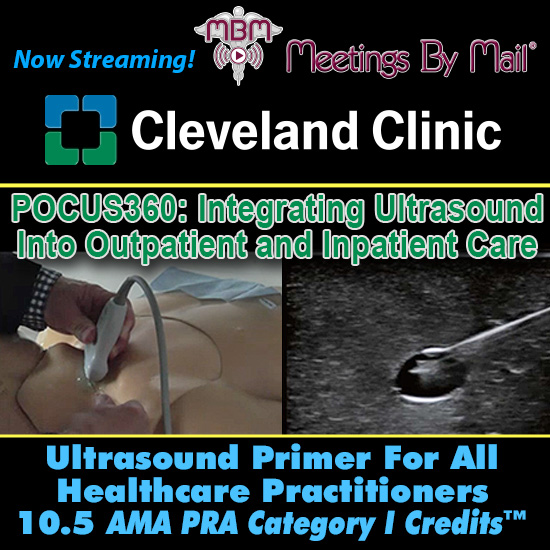
Integrating Ultrasound Into Outpatient and Inpatient Care features Cleveland Clinic’s expert faculty providing current state-of-the-art techniques utilizing ultrasound for diagnosis and guiding procedures in all settings. Skills learned throughout this activity should improve patient outcomes, and can be easily incorporated into current physician, nurse and physician assistant practices. Worth 10.5 AMA PRA Category I Credits™, with ANCC and AAPA accreditation provided, as well. Also worth ABIM and ABA MOC!
See full details chevron_right- Cost: $395
- Credit hours: 19.25 AMA PRA Category 1 Credits™
- CME credits awarded by: Cleveland Clinic Center for Continuing Education
- Format: On-Demand Online
- Expiration of CME credit: 7/14/2028
-
Ripple Health AI – The Physician’s Communication Toolkit: Navigating Patient Conflict
As a physician, equip yourself with a structured framework to de-escalate conflict and navigate high-tension interactions with patients. These practical tools foster trust and improve adherence, ensuring safer care.
See full details chevron_right- Cost: $200
- Credit hours: 2.00 AMA PRA Category 1 Credit™ Hours
- CME credits awarded by: Joint Providership by WSMA and Ripple Health AI
- Format: On-Demand Online
- Material last updated: 3/5/2026
- Expiration of CME credit: 3/4/2029
-
Ripple Health AI – Communicating with Patients: The 4 C’s of Relational Care for Physicians
Utilize a structured approach for every patient interaction to systematically improve adherence, efficiency, and patient outcomes.
See full details chevron_right- Cost: $100
- Credit hours: 1.00 AMA PRA Category 1 Credits™
- CME credits awarded by: Joint Providership by WSMA and Ripple Health AI
- Format: On-Demand Online
- Material last updated: 4/27/2026
- Expiration of CME credit: 4/26/2029
-
Ripple Health AI – The Nurse’s Communication Toolkit: Navigating Patient Conflict
As a nurse, equip yourself with a toolkit of essential and practical communication skills and a structured approach framework to foster trust, enhance understanding, and prevent breakdowns across every patient and family interaction, thereby ensuring safer care, improving adherence, and effectively managing complex and difficult situations.
See full details chevron_right- Cost: $50
- Credit hours: 2.00 contact hours / ANCC accredited approver, CNA
- CME credits awarded by: Provided by ANCC accredited approver, CNA with Ripple Health AI
- Format: On-Demand Online
- Material last updated: 3/6/2026
- Expiration of CME credit: 3/5/2028
-
AchieveCE Antibiotic Treatment for Complicated UTI
This course discusses the different FDA-approved antibiotics for the treatment of complicated urinary tract infections (UTIs). It talks about the pharmacology, clinical studies, adverse effects, dosage, and administration of Meropenem/Vaborbactam (Vabomere), Plazomicin (Zemdri), and Cefiderocol (Fetroja) for proper use.
See full details chevron_right- Cost: $19
- Credit hours: 1
- CME credits awarded by: The Medical Letter and AchieveCE
- Format: On-Demand Online
-
AudioDigest CME Clinical Guidelines and Updates Topical Collection
A new, comprehensive resource designed to support clinicians across all specialties. Whether you’re treating heart disease, infectious illnesses, or managing preventive care, this collection offers a unique blend of pharmacology updates and lifestyle intervention strategies. With topics ranging from pediatric obesity to hyperbilirubinemia in newborns, and from cell therapy to adult and adolescent vaccinations, Clinical Guidelines & Updates Topical Collection equips you with practical insights that can be applied directly to everyday care.
See full details chevron_right- Cost: $399
- Credit hours: 32.5
- CME credits awarded by: Accreditation Council for Continuing Medical Education
- Format: Audio
-
Ripple Health AI – Intentional Partnership: Building High-Performing Clinical Teams For Nurses
Champion high-reliability care by cultivating the intentional connections and collaborative behaviors that drive clinical excellence and team safety.
See full details chevron_right- Cost: $25
- Credit hours: 1.00 contact hour / ANCC accredited approver, CNA
- CME credits awarded by: Provided by ANCC accredited approver, CNA with Ripple Health AI
- Format: On-Demand Online
- Material last updated: 3/18/2026
- Expiration of CME credit: 3/5/2028
-
Ripple Health AI – Building and Supporting High-Performing Clinical Teams for Physicians
Build psychological safety and trust within the interprofessional team to mitigate clinical risk and drive high-reliability performance.
See full details chevron_right- Cost: $100
- Credit hours: 1.00 AMA PRA Category 1 Credits™
- CME credits awarded by: Joint Providership by WSMA and Ripple Health AI
- Format: On-Demand Online
- Material last updated: 3/31/2026
- Expiration of CME credit: 3/30/2029
-
Ripple Health AI – Nursing Professionalism: Better, Safer Care
Cultivate the core behaviors required to anchor high-reliability care.
See full details chevron_right
- Cost: $25
- Credit hours: 1.00 contact hour / ANCC accredited approver, CNA
- CME credits awarded by: Provided by ANCC accredited approver, CNA with Ripple Health AI
- Format: On-Demand Online
- Material last updated: 3/20/2026
- Expiration of CME credit: 3/19/2028
-
Ripple Health AI – Physician Professionalism: Better, Safer Care
Cultivate the core behaviors required to anchor high-reliability care.
See full details chevron_right- Cost: $100
- Credit hours: 1.00 AMA PRA Category 1 Credits™
- CME credits awarded by: Joint Providership by WSMA and Ripple Health AI
- Format: On-Demand Online
- Material last updated: 4/08/2026
- Expiration of CME credit: 4/07/2029
-
Ripple Health AI – Communicating with Patients: The 4 C’s of Relational Care for Nurses
Utilize a structured approach for every patient interaction to systematically improve adherence, efficiency, and patient outcomes.
See full details chevron_right- Cost: $25
- Credit hours: 1.00 contact hour / ANCC accredited approver, CNA
- CME credits awarded by: Provided by ANCC accredited approver, CNA with Ripple Health AI
- Format: On-Demand Online
- Material last updated: 3/20/2026
- Expiration of CME credit: 3/19/2028
-
RITZ-CARLTON IN WASHINGTON, D.C
HERmedicine – The Midlife Women’s Health Summit: Evidence-Based Menopause Care in the Era of Longevity Medicine – November 20-22, 2026
The Midlife Women’s Health Summit is three days of evidence-based education on menopause care as longevity medicine reshapes how patients think about aging. Sessions cover perimenopause, MHT prescribing, cardiometabolic and bone health, sexual health, and breast cancer risk and survivorship, with case-based discussions led by faculty who separate what the research supports from what’s being sold. Co-chaired by Lisa Larkin, MD, Jen Gunter, MD, and Lauren Streicher, MD, with faculty spanning menopause, cardiology, psychiatry, and oncology.
Held November 20–22, 2026 at The Ritz-Carlton in Washington, D.C. Worth 18 AMA PRA Category 1 Credits™, accredited by CineMed
See full details chevron_right- Cost: Varies
- Credit hours: 18 AMA PRA Category 1 Credit(s)™
- CME credits awarded by: CineMed
- Format: Live Conference