
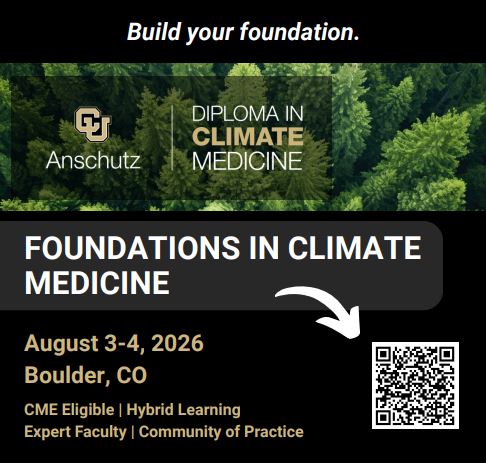
University of Colorado Anschutz – Diploma in Climate Medicine – Foundations in Climate Medicine Certificate
Foundations in Climate Medicine equips clinicians to understand and communicate the complex intersections of public health, climate science, energy policy, earth science, and governance. Participants learn to translate scientific insights—such as the links between extreme heat and urban illness, biodiversity loss and pandemics, or extreme weather and food insecurity—into actionable strategies for advocacy and policy change. Clinicians trained in Climate Medicine are uniquely positioned to craft patient-centered narratives that influence policymakers, community leaders, and health system decision-makers, advancing climate-resilient health policies, promoting environmental justice, and guiding health systems toward decarbonization.
Course dates: 2:00–5:00 p.m. Mountain Time, July 22, 24, 27 & 29, 2026 (Virtual portion), all day August 3-4, 2026 (In-person portion).
related;university-of-colorado-anschutz-climate-health-program;University of Colorado Anschutz – Climate & Health Program;Key Features
-
Examination of the health impacts of climate change, including air quality, extreme weather, heat, diet, and gender-specific effects.
-
Interdisciplinary sessions with renowned experts, including atmospheric scientists, environmental health specialists, and communication science professionals.
-
Facilitated sessions to explore how climate models work, including a hands-on experience running a model and observing climate data.
-
Field exploration with a land manager on the front lines of climate-driven wildfires and community impacts.
-
In-depth reviews of IPCC and National Climate Assessment reports.
-
Training in narrative medicine and climate communication, and strategies for effective change management.
-
Introduction to advocacy and oral testimony.
Topics Covered
- Climate Science for Clinicians
- Environmental Health Research
- Heat Illness
- Air Quality
- Infectious Disease
- Weather Events and Disasters
- Water Security
- Mental Health
- Food Systems and Diets
- Occupational Health
- Vulnerable Populations
- Healthcare Systems
- How to Teach Climate Medicine
- Fire Ecology
- Climate Modeling
- AI and Health
- Climate Communication
- Systems Thinking
- Environmental Justice
- Assessment Reports
- Narrative Medicine
- Advocacy and Oral Testimony
- Fossil Fuels and Health
- Career Opportunities
Learning Objectives
- Demonstrate knowledge about the scientific consensus on climate change and the concept of evolving science.
- Understand scientific knowledge related to climate change and human health across a number of pathways including: temperature-related illness, water security, extreme weather, natural disasters, food security, air quality, infectious diseases, and mental health.
- Apply knowledge of climate and health to clinical care of patients.
- Use information on regional climate impacts to improve local health services and delivery.
- Describe professional obligations of health professionals related to climate and health.
- Describe how to work collaboratively and across disciplines on climate change and health issues.
- Effectively communicate climate and health topics to different stakeholders (incl. patients, colleagues, communities, and policymakers).
- Demonstrate how to partner with elected officials, healthcare institutions, and professional organizations to advocate for climate policies that promote population and public health.
Target Audience
This activity is designed for healthcare providers from all disciplines and specialties.
Additional credit info
The Wilderness Medical Society designates this enduring material activity for a maximum of 49 AMA PRA Category 1 Credit(s)™️. Each physician should claim only the credit commensurate with the extent of their participation in the activity.
This activity has been planned and implemented in accordance with the accreditation requirements and policies of the Accreditation Council for Continuing Medical Education (ACCME) through the joint providership of the Wilderness Medical Society (WMS) and Climate & Health Program at University of Colorado School of Medicine. The WMS is accredited by the ACCME to provide continuing medical education for physicians.
Participants also earn a microcredential issued by the University of Colorado.