
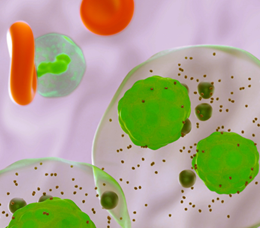
Boston University & Med-IQ: The Prevention, Monitoring, and Management of Adverse Events Associated With BCMA-Directed Bispecific Antibodies in Multiple Myeloma
Faculty discusses the prevention and management of cytokine release syndrome (CRS), immune effector cell–associated neurotoxicity syndrome (ICANS), and infections in patients with relapsed/refractory multiple myeloma treated with BCMA-directed bispecific antibodies.
This series was developed by Boston University Chobanian & Avedisian School of Medicine in collaboration with the American Academy of Physician Associates, the Association of PAs in Oncology, HealthTree Foundation, and Med-IQ.

Cost: Free
View Offer chevron_rightKey Features
Prevention and management of CRS, ICANS, and infections in patients with RRMM treated with BCMA-directed BsAbs.
Topics Covered
BCMA-directed bispecific antibodies for the treatment of multiple myeloma
Learning Objectives
1. Describe the diagnosis, risk factors, prevention, and management of CRS and ICANS
2. Recognize infectious complications associated with BCMA-directed BsAbs and implement strategies for their prevention
3. Establish and follow workflows and lines of communication for monitoring and managing BCMA-directed BsAb treatment-related adverse events
Target Audience
This program is intended for oncologists, hematologists, physician associates, nurse practitioners, nurses, nurse navigators, pharmacists, and other healthcare professionals responsible for the care and treatment of people living with RRMM.
Additional credit info
This activity is developed as a joint collaboration among Boston University Chobanian & Avedisian School of Medicine, Med-IQ, the AAPA, the Association of PAs in Oncology (APAO), and HealthTree Foundation.
nullIn support of improving patient care, Boston University Chobanian & Avedisian School of Medicine is jointly accredited by the Accreditation Council for Continuing Medical Education (ACCME), the Accreditation Council for Pharmacy Education (ACPE), and the American Nurses Credentialing Center (ANCC), to provide continuing education for the healthcare team.
Boston University Chobanian & Avedisian School of Medicine designates this enduring activity for a maximum of 0.25 AMA PRA Category 1 Credits™. Physicians should claim only the credit commensurate with the extent of their participation in the activity.
American Board of Internal Medicine Maintenance of Certification (MOC) Part 2 Credit. Successful completion of this CME activity, which includes participation in the evaluation component, enables the participant to earn up to 0.25 MOC points in the American Board of Internal Medicine’s (ABIM) Maintenance of Certification (MOC) program. It is the CME activity provider’s responsibility to submit participant completion information to ACCME for the purpose of granting ABIM MOC credit.
By participating and claiming credit, you agree to BU sharing your information with ACCME PARS the data conduit to the ABIM.
This activity is approved for 0.25 CPE credit. UAN is: JA0000185-9999-25-044-H01-P.
Nursing Contact Hours: 0.25, of which none are eligible for pharmacology credit.
Boston University Chobanian & Avedisian School of Medicine has been authorized by the American Academy of PAs (AAPA) to award AAPA Category 1 CME credit for activities planned in accordance with AAPA CME Criteria. This activity is designated for 0.25 AAPA Category 1 CME credits. PAs should only claim credit commensurate with the extent of their participation.