
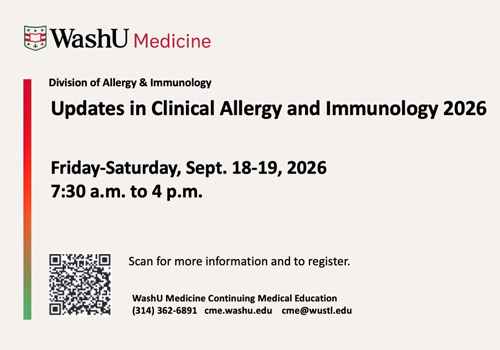
WashU Medicine – Updates in Clinical Allergy and Immunology 2026 – September 18-19, 2026
Supercharge your allergy and immunology practice in just a day and a half! Engage directly with top WashU specialists through expert-led lectures and interactive Q&A sessions covering the latest advances in allergic rhinitis, asthma, food/drug allergies, and cutting-edge biologic therapies. Upgrade your diagnostic accuracy, refine your management strategies, and earn up to 11 AMA, ANCC, or IPCE credits!
Held at LE MÉRIDIEN® St. Louis-Clayton 7730 Bonhomme Avenue, St. Louis, Missouri, 63105
Key Features
Interprofessionally planned and delivered by physicians and nurses to drive team-based care and best practices. Provides 1.5 days of expert lectures and interactive Q&A sessions on diagnostic and management updates across allergic rhinitis, asthma, food/drug allergy, and biologic therapies.
11 AMA, ANCC, IPCE Category 1 Credits™.
Topics Covered
- Allergic rhinitis & asthma
- Atopic & contact dermatitis
- Food & drug allergies
- Hereditary angioedema
- Emerging immunotherapy approaches & biologic therapies
- Diagnostic and management advances to improve patient outcomes
Learning Objectives
At the conclusion of this activity, learners will be able to:
- ASTHMA Counsel patients with asthma on step up treatments for asthma with biologics, taking into consideration patient preferences, insurance formularies, and potential side effects.
- ASTHMA Explain the various mechanisms underlying allergic responses, and how treatments for allergic conditions affect these pathways and symptom manifestations of allergic conditions.
- ALLERGIC RHINITIS Counsel patients on treatments, benefits, risks, alternatives for management of allergic rhinitis, including various forms of immunotherapy.
- ALLERGIC SKIN Differentiate the mechanisms and clinical characteristics of various allergic dermatological skin conditions, particularly hereditary angioedema, atopic dermatitis, and contact dermatitis.
- ALLERGIC SKIN Diagnose and develop treatment plans for patients with hereditary angioedema, atopic dermatitis, and contact dermatitis.
- FOOD ALLERGY Identify pediatric patients who would benefit from treatment with oral immunotherapy for the treatment of food allergy. Provide counseling for caregivers regarding benefits, risks of harm, and alternatives to treatment for food allergy.
Target Audience
This live in-person event is designed for allergists, immunologists, otolaryngologists, pulmonologists, internists, hospitalists, general & family practice physicians, pediatricians, pediatric allergists, pediatric immunologist, pediatric otolaryngologists, nurse practitioners, and nurses. It may be of interest to physician assistants, pharmacists, and all healthcare professionals who care for patients with allergic and immunologic illnesses.
Additional credit info
In support of improving patient care, Washington University School of Medicine in St. Louis is jointly accredited by the Accreditation Council for Continuing Medical Education (ACCME), the Accreditation Council for Pharmacy Education (ACPE), and the American Nurses Credentialing Center (ANCC), to provide continuing education for the healthcare team.