
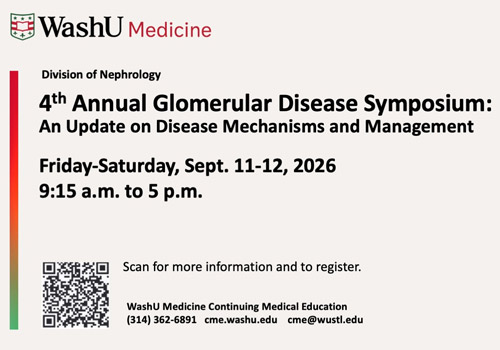
WashU Medicine – 4th Annual Glomerular Disease Symposium: An Update on Disease Mechanisms and Management 2026 – September 11-12, 2026
Master the cutting edge of glomerular disease care! Join top nephrology experts for an immersive, 14-hour experience featuring hands-on workshops, lively debates, case breakdowns, and Glomerular Disease Jeopardy. Upgrade your clinical skills and earn up to 14 AMA PRA Category 1 Credits™—with no post-test required!
Held at EPNEC – Eric P. Newman Education Center, 320 S Euclid Ave, St. Louis, MO 63110
Key Features
Comprehensive update on the latest advances in pathogenesis, diagnosis, and treatment. Includes interactive hands-on workshops, case discussions, panel Q&As, and Glomerular Disease Jeopardy across a 2-day schedule.
14 AMA PRA Category 1 Credits™.
Topics Covered
- IgA Nephropathy: Covers immunomodulation strategies, supportive care, and dedicated panel Q&A.
- ANCA-Associated Glomerulonephritis (ANCA-GN): Workshops and debate sessions on the targeted vs. judicious use of Plasma Exchange (PLEX).
- Lupus Nephritis: Explores triple therapy vs. de-escalation/maintenance strategies.
- Podocytopathy & Membranous Nephropathy: Covers genetic testing, diffuse podocytopathy, precision diagnosis, and antigen unmasking.
- Complement Dysregulation: Focused discussions on C3 Glomerulopathy and IC-MPGN.
- Onconephrology: Addresses glomerular disease in cancer and Monoclonal Gammopathy of Renal Significance (MGRS).
Learning Objectives
At the conclusion of this activity, learners will be able to:
- Evaluate and apply current evidence based diagnostic and therapeutic approaches across major glomerular diseases (e.g., IgA nephropathy, lupus nephritis, ANCA-Associated GN, podocytopathies, complement mediated disease, and onconephrology cases) to optimize patient management.
- Differentiate disease specific treatment strategies by interpreting clinical trial data, guideline updates, and expert panel recommendations to support individualized, precision based care decisions in glomerular disease.
- Integrate multidisciplinary insights (nephrology, pathology, genetics, and emerging therapeutics) to improve diagnostic accuracy and selection of targeted therapies in complex glomerular disease presentations.
- Critically analyze evolving controversies in glomerular disease management (e.g., immunosuppression intensity, timing of intervention, use of plasma exchange, and genetic testing) and apply structured clinical reasoning to realworld patient cases.
Target Audience
This live, in-person course is designed primarily for practicing nephrologists and nephrology trainees, and may also be of interest to rheumatologists, internal medicine physicians and trainees, advanced practice providers, and nephrology nurses.
Additional credit info
In support of improving patient care, Washington University School of Medicine in St. Louis is jointly accredited by the Accreditation Council for Continuing Medical Education (ACCME), the Accreditation Council for Pharmacy Education (ACPE), and the American Nurses Credentialing Center (ANCC), to provide continuing education for the healthcare team.