
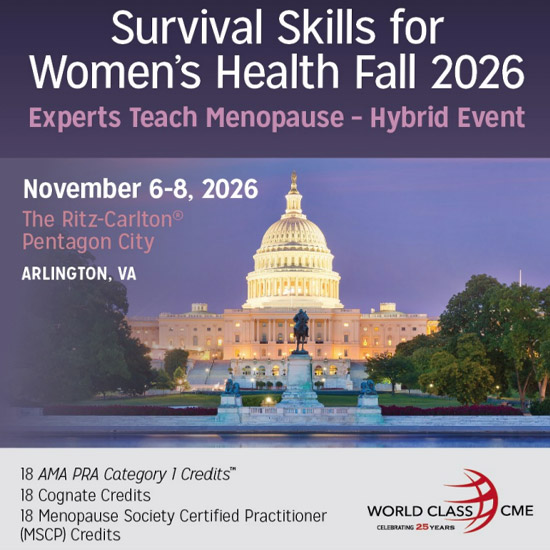
World Class CME – Survival Skills for Women’s Health Fall 2026 Experts Teach Menopause
“Women reaching the average age of menopause today were not yet 30 when the Women’s Health Initiative (WHI) reshaped care in 2002. At that time, perimenopause was largely unrecognized, and even today, training in midlife women’s health across nursing, medical school, and residency remains insufficient.
This comprehensive course provides state of the art, evidence based education on the care of women in perimenopause, menopause, and beyond. Sessions are designed to deliver practical clinical insights, actionable strategies, and real world pearls for daily practice.
Key topics include hot flashes and night sweats, sleep disturbance, hormone therapy risks and benefits (including testosterone), weight gain/obesity and osteoporosis management, mood and cognitive changes, low libido and sexual dysfunction, vaginal dryness and dyspareunia, and nonhormonal treatment options for all of these.
Lectures and interactive Q&A sessions are led by a multidisciplinary faculty of recognized experts in gynecology, primary care, breast health, psychiatry, dermatology, obesity medicine, sexual medicine, neurology, physical therapy, and nursing.
Attendees will leave with immediately applicable knowledge to improve patient outcomes in midlife women’s health. We look forward to welcoming you to an exceptional educational experience in Washington, DC.”
Program Directors- Drs. Steve Goldstein and James Simon
Cost: $1595
View Offer chevron_rightKey Features
Comprehensive evidence-based continuing medical education on the care of women in perimenopause, menopause and beyond.
18 AMA Category 1 Credits™
Topics Covered
Hormone therapy, including oncomedicine; bone, brain, body‑mass, dietary, pelvic‑floor, sexual, and skin health; evidence‑based screening and diagnosis; and appropriate treatment options for patient care.
Learning Objectives
Upon completion of this conference, the participant will be able to:
• Understand the reality vs the marketing of “compounded, synthetic, plant-based, bioidentical, etc.”
• Improve sleep management skills, particularly in perimenopausal and menopausal women.
• Appreciate the nuance of the menopausal transition toward a better understanding of the stage-related symptoms and their management.
• Manage premature ovarian insufficiency (POI) from diagnosis to treatment.
• Recognize Genitourinary Syndrome of Menopause (GSM) and its impact on quality of life while applying evidence-based hormonal and non-hormonal treatment options
• Advise overweight and obese patients with and without co-morbidities on successful weight loss strategies beyond simple diet and exercise, including use of available pharmaceuticals
• Understand the nuances of migraine and headache, with and without aura, and what the healthcare provider can, and should do for such a patient, including the new pharmacotherapeutic options
• Manage the menopause related gut microbiome toward better health and reduced disease
• Appreciate the impact of menopausal hormone therapy on the skin.
• Understand the importance of breast cancer risk assessment and risk stratification due to genetic (including dense breast) and non-genetic causes
• Gain confidence in adhering to guidelines for breast cancer screening with 3D mammography and appropriate risk-based additional screening protocols
• Dietary supplements: the facts and fantasies you should appreciate for evidence-based patient care.
• Become familiar with new and upcoming contraception options, especially for perimenopausal women.
• Assess breast cancer risk and provide evidence-based risk reduction strategies.
• Diagnose and treat the increase in cardiovascular risk that patients experience at midlife.
• Find the safety “sweet spot” using local and systemic menopausal hormone therapy after breast cancer without increasing recurrence risk.
• Evaluate abnormal bleeding and distinguish disease states originating in the endometrium and myometrium
• Implement strategies for assessment, diagnosis, and treatment of pelvic floor dysfunction, including surgical and non-surgical (physical therapy) options
• Add new competencies for managing menopausal symptoms, using both hormonal and non-hormonal approaches, while separating fact from fiction
• Understand the new longevity medicine: expanding the lifespan, health span, or both.
• Differentiate between low sexual desire and hypoactive sexual desire disorder (HSDD), and appreciate how to improve both by engaging evidence-based treatments
• Use office vaginal sonogram/sonohysterogram as a tool to improve care and reduce surgical interventions.
• Differentiate the physiological actions of estrogens from androgens, implementing evidence-based androgen replacement paradigms for improved health and sexual function
• Appreciate the role of transvaginal ultrasound in midlife women, both its pitfalls and usages
• Understand the mood and cognition changes occurring at midlife and their evidence-based treatment by generalists and when to refer for specialist care
• Understand metabolic syndrome, prediabetes, and other cardiovascular risk factors, appreciate their diagnosis and current treatments toward better cardiovascular health and disease prevention
• Adopt a holistic approach to skeletal health for the prevention of bone loss and treatment of osteoporosis using both antiresorptive and anabolic agents
Target Audience
Obstetrician- Gynecologists, Internists, Family Physicians. Nurses, Nurse Practitioners, Physician Assistants and Certified Midwives committed to advance care in perimenopause, menopause and midlife in women's health.
Additional credit info
Accreditation – World Class CME is accredited by the Accreditation Council for Continuing Medical Education (ACCME) to provide continuing medical education for physicians. World Class CME designates this live activity for a maximum of 18 AMA PRA Category 1 Credits™. Physicians should claim only the credit commensurate with the extent of their participation in the activity.
The American College of Obstetricians and Gynecologists has assigned up to 18 cognate credits to this program.
Nurse Practitioners and RNs -The American Nurses Credentialing Center and The American Academy of Nurse Practitioners Certification Program accept continuing education credits sponsored by organizations, agencies, or educational institutions accredited or approved by the ACCME.
Physician Assistants (PA) – The American Academy of Physician Assistants accepts AMA PRA Category 1 Credits™ from organizations accredited by ACCME. This course qualifies for Category 1 CME for PAs.
Certified Nurse Midwifes (CNM) – The American Midwifery Certification Board (AMCB) accepts Category 1 CME approval from organizations accredited by the ACCME.
Menopause Society Certified Practitioner (MSCP) – You will receive a record of attendance for submitting up to a maximum of 18 CMEs to the Menopause Society.